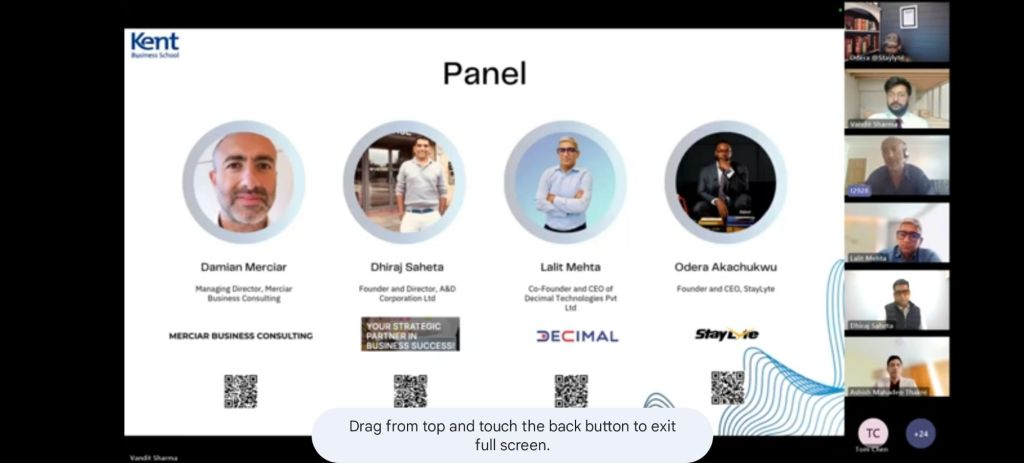
On the back of my post last week discussing “Economics as Applied Philosophy”, and a generous invitation to speak, here I am explaining it to MBA students at the University of Kent.
I choose two out of arguably an infinite number of applications, one expressing a true macro scale (the economic rationale underpinning the geopolitics of conflict); and the other representing a true micro scale (the economic audit that comprises the Periodic Review in the water industry, reporting to Ofwat).
So, here’s me being important… apparently I’ve saved corporations “billions” rather than the “millions” that I showed, but hey what’s a consonant between friends? I’m the first speaker for around 15-20 minutes, from minute 4 or so…
Awkward marketing on their side in that they keep the cover slide up on screen, instead of the speaker talking..
I’ve always taken it as a matter of pride to be interested in International affairs. I think as an Economist, the dots you join are not sectoral, or discipline based, or regional, or intellectual, or even psychological… I’ve always believed Economics to be fundamentally this: “applied philosophy” (the study of the fundamental nature of knowledge, reality, and existence, especially when considered as an academic discipline.)
What am I rambling on about now? 😂🤦🏻 Well, I’ve spoken before about the modern siloing of Economics – microeconomics being curtailed by the rigidities of linear regression; macroeconomics being subject to the vagaries of the bond market and yield curve analysis (which in my book has a lot more going for it than the straightjacket of linear regression!)
However this isn’t enough. Economics is much more than this – as can be seen, again, by a conference on the relationship between China and India, hosted by the wonderful Chatham House, of which I’m proud to be a member… Applied philosophy if it is to be useful, (as per my argument for this designation for Economics), is predicated on everything. Everything. Sociological subtleties between one county and another (eg Lancashire vs Yorkshire in cotton vs woolen production, which of course was also based on geographic attributes)… Right down to why do I consider it necessary to arm myself against my fear of you invading me? (Tensions over the China/India border).. running on of course to, where do I buy my weapons from? Will I get a better deal from a country that wants me to act as a proxy on their behalf… in arming myself more comprehensively do I present as a more secure trading partner or a more volatile one? Am I contributing to my own industrial development, through enhanced weapons technology that can translate to domestic industry? Will my safety enhance my prosperity or promote a rivalry in productivity and trade that I hadn’t foreseen (the emergence of other southeast Asian economies as China moves up the value curve).
The world is changing. Trump has inadvertently switched on a macrocosm of geopolitical and geo-economic activity, through his ignorant blunderings. We may well come to thank him when the dust settles…
Treason. If I was an American this is what I would be saying that my President was guilty of. There will always be ups and downs, but as far as everybody was concerned the American economy was functioning as it should, subject to policy variations, inflections on interest rate adjustments, exposure to foreign currency movement and generally subservient to, and subject to, the bond market (US Treasuries ) – which as the debt and budget management provider of first/last resort, all seemed to be a perfectly reasonable proposition…
And then President Trump comes along and based on mercantilist perspectives on trade – and his own unknowable psychology – he decides to play a version of Russian roulette with the world economy. Again, based on zero sum methodology, that simply has no place whatsoever in international trade – or diplomacy. In fact not only does it not have a place, it is precisely the worst way imaginable to approach your allies, whether it be from an economic or a political standpoint. Janet Yellen today described Trump’s measures as the worst act of self-harm on a perfectly functioning economy.
Technical economics sometimes finds it hard to discount for ephemeral variables such as pride – yet this is precisely what is on show in China’s refusal to dance to Trump’s music. As far as I’m concerned – why should they? (Other than the pretty obvious reasons of trying to avoid the continuation and magnification of self inflicted wounds, through the application of somewhat similarly extortionate tariffs on imports from the US… But what’s a chap supposed to do, right?)
One thing that screams out is – where are all these constitutional protections that academic lawyers in jurisprudence have always so celebrated in the US Constitution? How can a guy, that in so many other instances one imagines could easily be sectioned, be allowed to wreck havoc in the international economy, embarrass his nation, and present as entirely transactional, relationships cultivated over a century of goodwill between allies?
I’d say hand me the popcorn, as this is some show – except that tariffs on corn, maple syrup and the wood pulp for the box it comes in, have now pushed the price of the popcorn up to more than the movie…
Europe can simply not live under the threat of continued Russian intimidation. I’m with Zelenskyy. Europe needs its own Army.
As an Economist who also works in the geopolitical realm, yet who happens to be a former soldier – for me it is truly more straightforward than I think politicians and diplomats are leading us to believe. Offense, or the threat thereof, is almost always the best form of Defense. Mutually Assured Destruction, whatever the minor variations it has undergone during and post Cold War, essentially remains the backbone of nuclear realpolitik. European NATO member armies, Russia knows, have been dangerously underesourced.
Building up of European Defense budgets to 3.5% of GDP should be considered critical to National Security. In the case of Britain where we are currently moving towards 2.5%, an additional 1% would represent circa £30 Billion pounds. This is absolutely not an insignificant sum, yet in comparison to living under the subjugation of ongoing threat posed by Russia, it really is a price we can’t afford to not pay. From my very first involvement with the British Army, as a junior Officer Cadet, to, after leaving and rejoining – when I left 10 years ago, manpower had reduced from 130,000 to roughly 77,000 (now circa 73k). Given perhaps roughly only 1/3 of these are deployable Infantry, our current numbers are tactically of limited use. Let alone the degradation in ammunition supplies that we have permitted (given to Ukraine and not replaced).
Like Churchill in the late 30s, I would say we should re-arm and “up-arm” now, and I personally would go so far as to say we should attack Russia first. I for one don’t like living with the threat of a boot on my throat.
But I also hope that this brings into the minds of those who are at the very pinnacle of our society, the loss and devastation of those more vulnerable around the world. The losses that they have experienced for generations.
Gaza.
The displaced of Ukraine.
Sudan, the world’s worst catastrophe caused through War.
And countless others, both conflicts and areas subject to natural disaster. These people have memories. They had schools that they once went to, now destroyed.
Gaza, of all of these, is the most pernicious and industrial scale of destruction, and from whom Western eyes of solidarity seemed to have found it the most easy to turn away from…
Tariffs: “An eye for an eye makes the whole world blind”
Where do we start with the very bad idea that tariffs are good for anybody? “Tariff is a beautiful word”. When I first heard that Trump had said this I genuinely didn’t understand it. I thought perhaps it was a misspeak or something – so obvious is the fact that tariffs are only a force for damaging both the imposer of the tariff, as well as the recipient.
David Ricardo is one of the founding fathers of Economics and his instrumental principle of Comparative Advantage has led to the creation of international trade, in which countries that excel at producing certain things trade them with countries that excel at producing different things. Ergo, the net gain is greater than the sum of its parts. Even this statement shouldn’t really need to be explained: the fact that we trade, is itself a benefit. By imposing stringent tariffs on any product – and particularly a technologically advanced product, from which by exposure to the presence of that product in our marketplace, it is likely to prompt competitive innovation in the production of a rival product, or novel and innovative ways of including this product in day-to-day living, in ways that had previously not been considered. Either way, invariably it is a win-win. The fact that BYD appears to have become better at making electric cars than Tesla, may not be great news for Tesla but it’s certainly is for the consumer, and thus the transition to electric vehicles.
Tariffs are a very powerful mechanism for the retardation of economic growth. They are also a fairly effective mechanism for prompting homegrown inflation, requiring either domestic interest rate rises, or at best delayed interest rate reductions – all of which will further retard investment in potentially additional productive capacity: thereby reducing economic growth. A downward spiral of retrenchment, both economically and technologically.
And that is before we get into the geopolitics of isolationism. Again, it’s Diplomacy 101: talking with, and trading with economic partners, particularly post Second World War, has shown that we are much less likely to invade each other and treat each other as a latent threat.
Trump’s ascendancy, like Brexit, doesn’t have an economic rationale. It’s a sociological and political manifestation of fear: fear of the unknown, fear of “the other”; fear of being swamped, fear of losing identity, sovereignty and self-determination… Time after time history has shown us that isolationism and retrenchment exacerbates these fears rather than alleviating them. Tariff is not a beautiful word.