On reflection, should Rachel Reeves have given an entirely different Spring Statement last week, given that days before, this conflict with Iran had begun and the gilt markets were spasming? They have now trended up… Depending on the length, intensity, and whether or not the UK does involve itself substantially, our entire economic projection in the short to medium term could be altered by this conflict. The fundamentals of her presentation had shifted, and actually a “holding statement” could credibly have been issued in Parliament. Similarly, should this conflict end within the week – as has been signalled – it could have simply resembled a blip in the yield curve… That is before the fiscal reality of how to bring forward structured Defence spending kicks in. It appears worse than this in that of our six Destroyers only three are operational, and two of these are in even lesser states of readiness than HMS Dragon. Again it’s not just Naval deployment It’s also the rather serious consideration of the fact that RAF Akrotiri, as one of our key bases in the entire Middle East area (technically the near East), should have had far more proficient and aircraft and anti-drone technology. This has been known about for a long time. I myself visited Akrotiri when I was in the Forces a number of years ago and then it felt like it was something from the 70’s. I dare say it has now moved forwards to the 90s, but there is still much work to do…
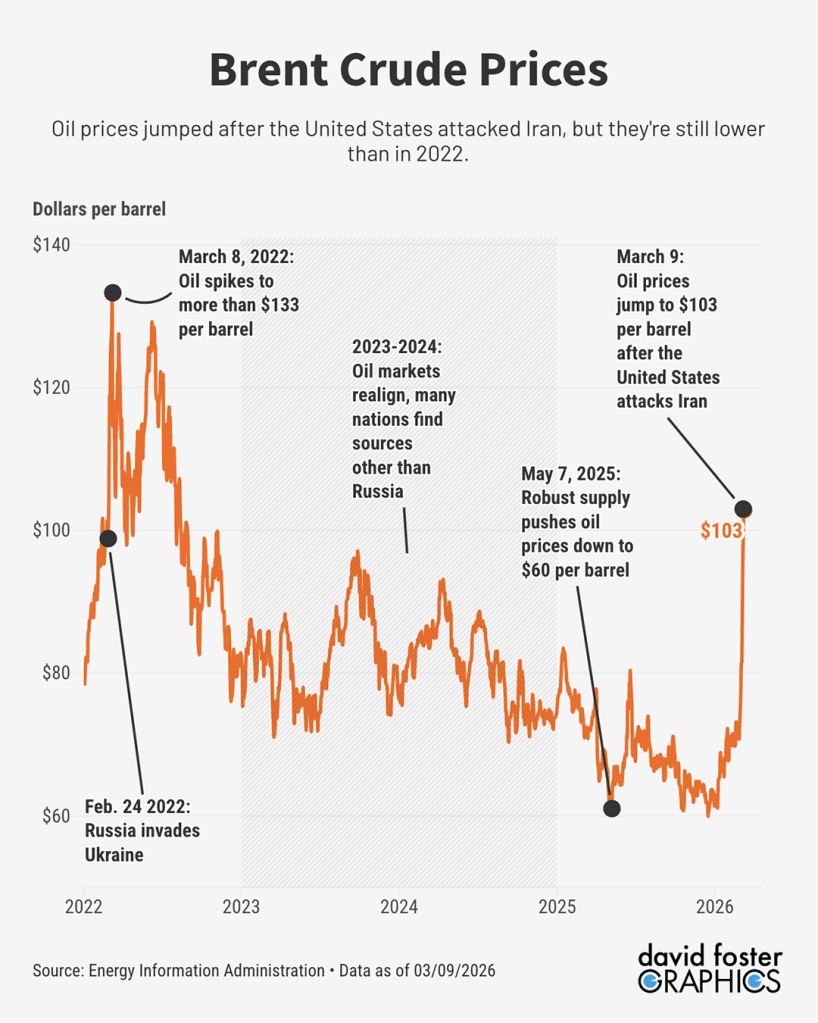
Strategically this US/Iran conflict is a disaster. Negotiations were progressing on the nuclear front, literally the day before Trump decided to mount these attacks. There is no pause for reflection, no moments of quiet; no concept whatsoever of an overarching strength projection, on the part of the US. They said they wanted to silo and focus on themselves, and in the last 3 months alone they have intervened in Venezuela, Nigeria and now Iran.. spending resources and reallocations of materiel, with zero clue as to their intended function. Military Assets are duly not correctly configured for East Asia, and a host of other strategic irregularities. Not least the Iranian conflict strategically benefits Russia by a changing away of the gaze, and by the US themselves acting as first aggressor.. And, of course tactically, by a significant increase in oil price and a potential realisation in the value of Russia’s enormous gas assets.
Quiet – If only the US could simply sit and contemplate what they actually want: no ICE domestically, and, no gung-ho internationally, whilst they do this. These random and inconsistent acts on the international stage diminish the US as the leader of the free world. This free world needs a more stable, “Daddy”, as Mark Rutte, obsequiously referred to Trump – in his capacity as Head of NATO, of course, playing to his vanity, whilst illustrating NATO’s impotence – instead of powering forwards the diplomacy required for far more powerful, succinct and orchestrated European defence integration.
Email us for assistance with your economic, strategic and geopolitical needs.
#Iran #Gas #Geoeconomics #Conflict #US

 MERCIAR BUSINESS CONSULTING