Commander in Chief…

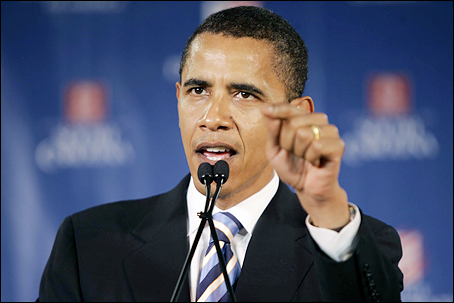
In this period, known as the “lame duck” interregnum, we are anxiously awaiting the emergence of the new administration at the start of the new year, with the inauguration of President Elect Barack Obama.

A jump in unemployment figures for the third quarter 2008, a burgeoning deficit and unsustainable spending on military endeavours abroad, expectations can justifiably be said to be high. Obama has been cautious in his rhetoric since being elected, he aims to temper his speeches with a clearer sense of limitation than when still campaigning. Recently he said words to the effect of “this country is governed by one Administration at a time”. Many have seen him as a soothsayer, others just look longingly into a vision of a future more embracing of the rest of the world. Partners, not colleagues.

It’s time the refrain – “Only in America” applied across the developed nations. It’s time troops were drawn down from both Iraq and Afghanistan – from all participant countries; it’s time that the protectionist policies of the Bush Administration were once again discarded for free trade liberalism.

It truly is an amazing story, and as a person of mixed heritage, I myself can bear testament to the fact that you simply have to be better, bolder and stronger to stand out. Barack Obama is a rhetorician the like of which world diplomacy has not seen for perhaps half a century. Let us pray that he has the belief and circumstance in all quarters of US Government to support this vision.

Lessons for business leaders…

When Peter Mandelson left Government the last time, it was with a deep and unresolved resignation – he hadn’t achieved what he had set out to achieve. There was also widespread sympathy amongst those “in the know” that he had perhaps been pushed too early and too hard by a crisis avoidant Alastair Campbell. Campbell himself later came to recognise that his dismissal of Mandelson had been a hammer to crack a nut….However, Mandelson had the last laugh – the only other world figure produced by this Labour Government, and British politics of the last decade was Tony Blair himself – and that possibly includes George Robertson’s stint as Nato DG.Thus – Secretary for Business, in the dying days of a winged Labour Administration, is nothing other than a demotion – even if one self inflicted.The lesson for business leaders is clear – don’t let vanity and the personal need to re-write history deflect you from an otherwise clear and successful strategic move. Let alone one that has reaped significant advantages already and has yet to run its (likely more fruitful) course…

1929 and all that….

What is the moral of the story? That in an upturn we are too busy reaping the rewards to be worried by the fetters that increased regulation would place on an otherwise functioning marketplace?

That’s precisely the point – market makers, traders, analysts, regulators, financiers and politicians all have benefitted from twenty years of light touch regulation. We tell ourselves that the market is cyclical, but then the downturn, without fail, shocks us.

Jobs are lost in their tens of thousands – sometimes within weeks, and potentially this time, within days. HBOS was a successful long established and well run company, well financed with a sustainable savings ratio to the outstanding loans. It was aware of investors’ hesitations and resolved them earlier this summer by securing an extra £4BN of funding through a rights issue – whereas RBS raised £12BN though the same means and was considered “safe” and spared the run that saw HBOS sold to Lloyds for £12.2BN – a third of its value of a year ago.

The biggest news of course, is the demise of Lehman Brothers – another great Wall Street bank – within a week of its Chief Executive’s optimistic view that the Korea Development Bank would take over, Lehman filed for Bankruptcy. The biggest ever filing, with liabilities of $613BN. Meanwhile, Merrill Lynch, an elite investment bank, sold itself to Bank of America for $50BN – half its $100BN value of less than a year ago. Morgan Stanley is in merger talks: this is three of the top four US investment banks, leaving only Goldman Sachs to ride out of the other side of this crisis. AIG has been rescued at a cost of $85BN to the US Treasury – who now own a near 80% stake in the huge insurer. The rationale? To stem the destructive fleeing from all things financial, and allow real world businesses, such as home & vehicle insurance, to continue.

There are too many “told you so” pundits popping up, sagely offering reproaches to anyone who’ll stop ringing around for interviews to listen. But that’s partly it: only with the sort of financial innovation that allowed these re-packaged debt products to flourish, was the wealth that they brought into the financial system celebrated. The bulk of that wealth though stayed within the financial system. In the US, the investment & financial services sector is a tiny proportion of GDP – yet almost a third of all corporate profits were reported by this sector last year. That’s money that is being paid in huge bonuses, and not going back as share dividends, companies’ investment capital and pension contributions. Perhaps we need a leaner financial sector. Perhaps we’ve now got one.

Monumental Achievement – Adam Smith…

Three years in the making, Dr Madsen Pirie, President & Dr Eamonn Butler, Director, of the Adam Smith Institute achieved a world first: the first major public monument to Adam Smith. Unveiled by Nobel Prize winner in Economics, Professor Vernon L. Smith, the magnificent statute was revealed to the world on July 4th 2008, during two days of celebrations. Standing ten feet tall, upon a ten foot pedestal, the striking bronze monument is a fitting, and belated, tribute to the pioneering economist and key thinker of the Scottish Enlightenment. From ASI’s own website, we learn that:

“The Statue shows Smith in later life — he spent his last years in Edinburgh — but still strong. Behind him is a plough, modelled from a contemporary plough in the Scottish Farming Museum, reminding us of the agrarian economics which Smith supplanted. Before him is a beehive, a symbol of the industry on which he believed progress was based. On top is a globe on which Smith rests his hand — made invisible by his academic gown. The gown itself reminds us of Smith the philosopher, exploring eternal ideas; and behind, St. Giles’s Cathedral completes the evocation. From the other side, we see Smith’s 18thC dress, with the City Chambers beyond, reminding us of Smith the economist, dealing with practical matters. His neckware is modelled on that worn by Thomas Jefferson, his wig is based on one of George Washington’s — recalling Smith’s strong support for free trade with America.”

Funded entirely by private donations, it is an outstanding reminder of his role in founding modern economics.

When art comes home…

This is one of those rare pieces that actually has personal content. The Blog is primarily a starting point for discussion of recent events from a business, economic and political perspective.

However, on a recent visit to my home city of Liverpool, I went to take a closer look at the standing sculpture of Antony Gormley’s “Another Place”.

Feelings have been high over this installation; feelings that it has little or nothing to do with the industrial heritage, indeed commercial present, of today’s Liverpool. In this photo, we see a serene and beautiful panorama. If one does a 180 degree turn, you will look directly towards the brute commerce of Liverpool’s container docks. What was the centre of maritime commerce not only for Great Britain, but for the world. At the start of the 19th Century over 40% of the world trade – and more than this by way of value – was passing through Liverpool. What, other than gazing at times past, does Antony Gormley’s iron men signify for Liverpool?

Well, I would argue that this isn’t the point. I know this beach profoundly well – in fact here on this website it shall first publicly be cited as “my beach” (I claimed ownership approximately aged 8). I grew up here and knew every eddy, the tidal reach, the coldness of the water and the danger of the sands. I am uniquely qualified to say that this stretch of land has never looked so good. The high power wind turbines in the distance are precisely indicative of the fact that Liverpool is very much part of the modern world. Out of shot to the right of this, further out in Liverpool Bay, sits a large incandescent gas rig. One energy source replaces another: Liverpool becoming critical as a centre for the UK offshore energy industry. New industries of multimedia, stemming from Liverpool’s centres of excellence at two of its three universities – another important revenue and creative force for the city – and television production through Granada Studios, show that perhaps the city has finally turned a corner. Few people would believe that Europe’s largerst property development project has just been completed this summer at “Liverpool One” a gargantuan shopping and office complex, generating thousands of new jobs. For the lower skilled there is now employment in call centres dotted around the city, themselves leading change in what had previously been a criticised work environment, but one that has the capacity to soak up many of the displaced workers from the city’s heavier industrial past. With European Capital of Culture 2008 also now securing a strong and proud base from which to venture, back into the whole of the world that was originally only accessible from this port.

Alistair Darling’s first Budget…

Today, the Chancellor Alistair Darling delivered his first budget, prompting what can only be described as a lacklustre response. Financially cautious with limited social engineering intentions, it aimed to be a budget that halfway nodded towards the preoccupations of the moment.

These include green levies, such as the “aim” to levy a charge on plastic bags. Fuel tax manipulation has been put on hold, with an acknowledgement of $110 oil having pushed petrol prices to an already recent high. On Growth, the forecast for this year has been lowered to between 1.75 and 2.25 per cent. On Inflation, recent fuel and energy prices will stoke inflation during 2008, though he predicts a return to target (Target – 2%), by 2009.

On Public Spending:  to grow by 2.2 per cent in the next three years. On business, an interesting aim: target for small and medium-sized businesses to win 30 per cent of public sector contracts in the next five years. On Tax – new charge (anticipated at £30,000) on non-domiciled residents to be introduced from April and to remain in place for present and the next parliament. Beer duty to increase by 4p per pint, wine up 14p a bottle, cider up 3p a bottle and spirits up 55p a bottle. This could put the price of a pint in a typical pub, up by 12-15p, once VAT and margins accounted for – and the price of a bottle of spirits by 80p in a supermarket. These are significant increases and reflect growing Parliamentary acknowledgment of the need to “do something” to halt the permissive and pervasive attitude to drink in this country. Campaigners are not convinced that the tax system is the mechanism for achieving this change.

Tobacco duty to rise tonight by 11p per packet of 20 cigarettes and 4p for five cigars.

Supporting Budget 2008 documentation can be obtained  from the  UK Treasury’s own site at http://www.hm-treasury.gov.uk/budget/budget_08/documents/bud_bud08_docsindex.cfm

We would argue that this is a profoundly flat budget, short on ideas, limited in scope and desperate for inspiration. Financially it states that extra revenue gleaned through additions to Duty will be re-directed to pulling more poor children out of the definition of poverty. Raising Child Benefit to £20 for the first child being the chief means of achieving this end, coupled with micro measures such as adjusting Child Tax Credits. These, however, are small beer and seem if anything, to be the tired and heavy breathing of a Government in much need of the recuperation of Opposition.